
How AI Is Changing Electronic Signatures
 Deep MorkerLast Updated: Aug 18, 2026
Artificial intelligence is transforming electronic signatures by making digital document workflows smarter, faster, and more secure. Electronic signatures already simplified document signing by replacing paper-based processes, and AI now builds on that foundation with intelligent automation, identity verification, fraud detection, and workflow optimization.
AI-powered electronic signature solutions can analyze documents, detect errors, verify signers, and streamline approvals with minimal manual effort. This article explains how AI is changing electronic signatures, the technologies behind the shift, and the benefits businesses gain from adopting AI-driven document workflows.
Key Takeaways on AI and eSignatures
- AI automates document preparation, review, and approval workflows.
- Intelligent document analysis reduces manual errors before signing.
- AI strengthens security through fraud detection and identity verification.
- Machine learning helps optimize approval workflows and contract management.
- Businesses can improve efficiency, compliance, and customer experience with AI-powered electronic signatures.
What Is AI in Electronic Signatures?
Artificial intelligence in electronic signatures refers to the use of technologies such as machine learning, natural language processing (NLP), optical character recognition (OCR), and predictive analytics to automate and enhance digital document workflows. Instead of simply providing a platform for electronic signing, AI-enabled solutions actively assist users by understanding document content, identifying potential issues, verifying identities, and recommending actions based on historical data.
For example, AI can automatically recognize document types, extract important information such as names, dates, payment terms, and contract values, and confirm that all required signature fields are completed before documents go out for approval. This minimizes manual effort while reducing the errors that delay business processes.
Unlike traditional electronic signature platforms, AI-powered systems continuously learn from document interactions, which lets them improve workflow efficiency and offer smarter recommendations over time.
Why AI Matters for Digital Document Workflows
Modern organizations process hundreds or even thousands of documents every month. Contracts, invoices, employment agreements, purchase orders, compliance forms, and customer agreements all require careful review before they can be signed. Handling these documents manually consumes valuable time and increases the risk of errors, missing information, and compliance gaps.
AI eliminates many of these challenges by automating repetitive tasks that traditionally required significant human effort. Instead of reviewing every document by hand, employees can rely on AI to identify missing signature fields, validate document completeness, classify document types, and route files to the appropriate stakeholders.
AI also lets organizations process large volumes of documents much faster while keeping approval workflows consistent. That matters most for enterprises with distributed teams, remote employees, or global operations, where speed and accuracy directly affect business performance. It builds on the same operational case that drives businesses to adopt electronic signatures in the first place.
By combining automation with intelligent decision-making, AI helps businesses move beyond simple digital signatures toward end-to-end document workflows that are more efficient, secure, and scalable.
Intelligent Document Processing
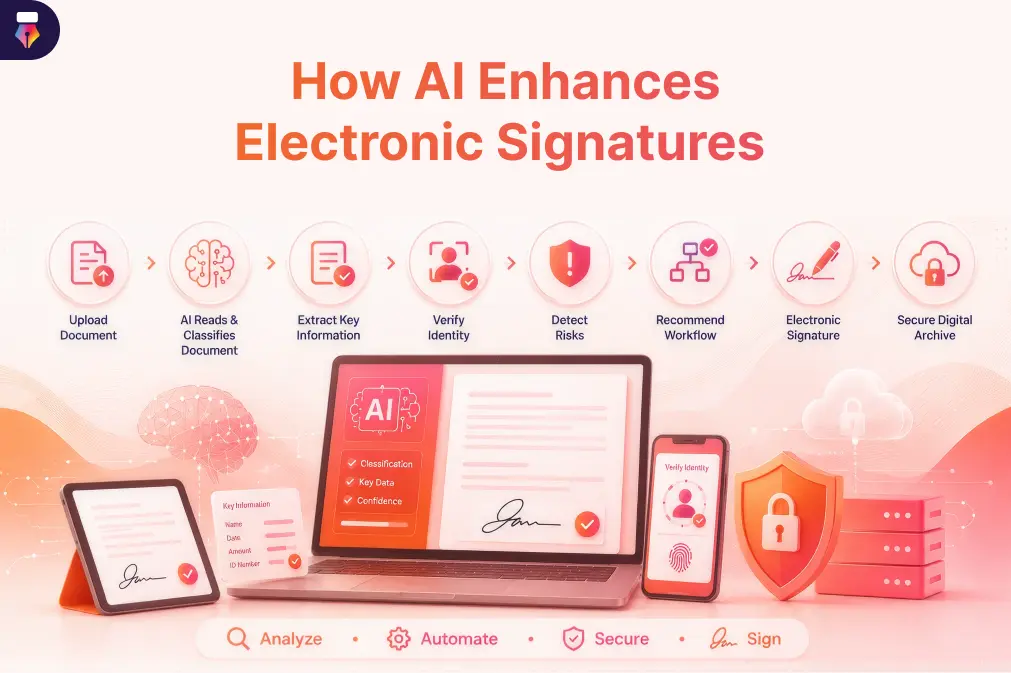
One of the most significant ways AI is transforming electronic signatures is through Intelligent Document Processing (IDP). This technology combines optical character recognition, machine learning, and natural language processing to read, understand, and process documents automatically.
Instead of relying on employees to review contracts or agreements line by line, AI extracts key fields from an uploaded document such as names, addresses, payment terms, renewal dates, and legal clauses. It can also classify documents, identify missing information, and recommend the next step in the approval process.
What AI Can Extract Automatically
- Customer information
- Contract values
- Invoice numbers
- Renewal dates
- Payment terms
- Legal clauses
- Signature locations
- Company details
What Automated Extraction Saves a Document Team
- Faster document preparation
- Reduced manual data entry
- Improved accuracy
- Better compliance
- Quicker approvals
- Lower administrative costs
Business example: An HR department uploads hundreds of employment contracts into an AI-enabled electronic signature platform. The system automatically extracts employee details, verifies required fields, places signature blocks, and routes the documents to the right managers, turning hours of manual work into a few minutes.
AI-Powered Identity Verification
One of the biggest challenges in digital document signing is confirming that the person signing is genuinely who they claim to be. Traditional electronic signature platforms rely on email verification or basic authentication. Those methods provide a reasonable level of security, but they may not be sufficient for high-value contracts, financial agreements, or regulated industries.
Artificial intelligence strengthens identity verification by analyzing multiple data points before a document can be signed. AI-powered systems can validate government-issued IDs, compare facial recognition data, detect suspicious login attempts, and analyze user behavior in real time.
Machine learning algorithms continuously improve their accuracy by learning from millions of authentication events, which makes it increasingly difficult for fraudulent users to bypass security controls.
How AI Confirms a Signer's Identity
- Facial recognition
- Government-issued ID verification
- Biometric authentication
- Multi-factor authentication (MFA)
- Device recognition
- Behavioral biometrics
- Location-based verification
Why Stronger Verification Pays Off
- Stronger identity assurance
- Reduced impersonation risks
- Faster customer onboarding
- Improved regulatory compliance
- Enhanced trust in digital transactions
Business example: A financial institution asks customers to sign loan agreements digitally. Before granting access to the document, the AI platform verifies the customer's identity using facial recognition and government-issued ID validation. That extra layer helps prevent identity fraud while keeping the experience seamless.
Inkfree offers several recipient identity verification options so teams can match the level of assurance to the sensitivity of each document.
AI-Powered Fraud Detection and Risk Analysis
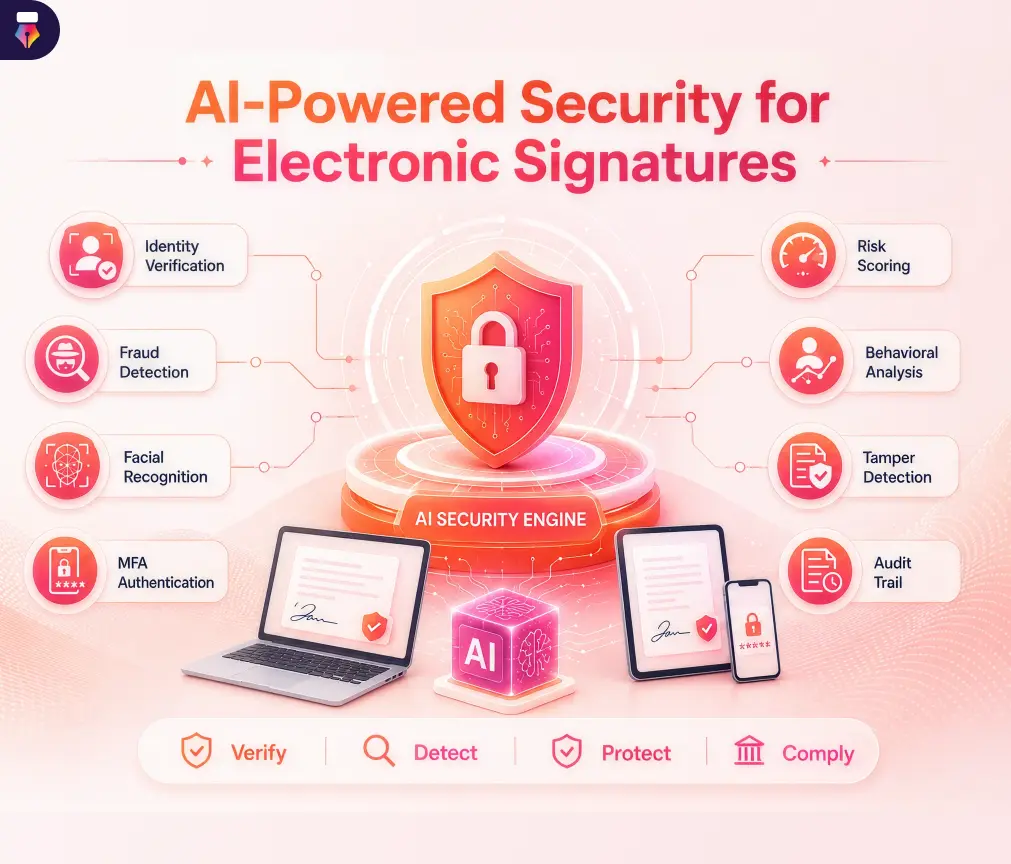
Preventing fraud is a top priority for organizations that manage sensitive documents. AI addresses this by continuously monitoring document activity and flagging behavior that could indicate fraud.
Unlike traditional rule-based systems, AI analyzes historical signing patterns and user behavior to identify anomalies in real time. If the platform detects unusual login locations, repeated failed authentication attempts, altered documents, or abnormal signing behavior, it can automatically trigger additional verification or alert administrators.
This proactive approach reduces fraud risk without slowing down legitimate business transactions, and it complements the security and compliance controls already built into the platform.
What AI Can Detect
- Suspicious login attempts
- Unusual signing behavior
- Document tampering
- Identity inconsistencies
- Unauthorized access attempts
- Duplicate signing activities
- High-risk transactions
What Early Fraud Detection Protects
- Better fraud prevention
- Stronger document integrity
- Reduced financial risks
- Improved compliance
- Greater customer confidence
Expert insight: AI does not replace security policies. It enhances them by continuously monitoring risks that would be difficult for humans to spot manually, so organizations get faster threat detection while legitimate users keep a seamless signing experience.
Smart Workflow Automation
Beyond document security, AI is changing how organizations manage approvals. Traditional document routing requires employees to assign approvers, send reminders, and monitor progress by hand. AI automates those repetitive tasks by understanding business rules and recommending the most efficient path.
For example, AI can determine which manager should approve a purchase request based on its value, or route contracts to the legal team when specific clauses appear. It can also prioritize urgent documents, send intelligent reminders, and notify stakeholders when approval workflows stall.
This level of automation reduces administrative effort while keeping documents moving without unnecessary bottlenecks.
AI Workflow Capabilities
- Automatic document routing
- Smart approval recommendations
- Intelligent reminders
- Workflow prioritization
- Service-level monitoring
- Approval escalation
- Predictive bottleneck detection
What Automated Routing Frees Up
- Faster approval cycles
- Reduced manual effort
- Improved productivity
- Better collaboration
- Consistent business processes
AI-Powered Contract Intelligence
Contracts hold valuable business information, but reviewing them manually is slow. AI-powered contract intelligence lets organizations extract, analyze, and manage contract data automatically.
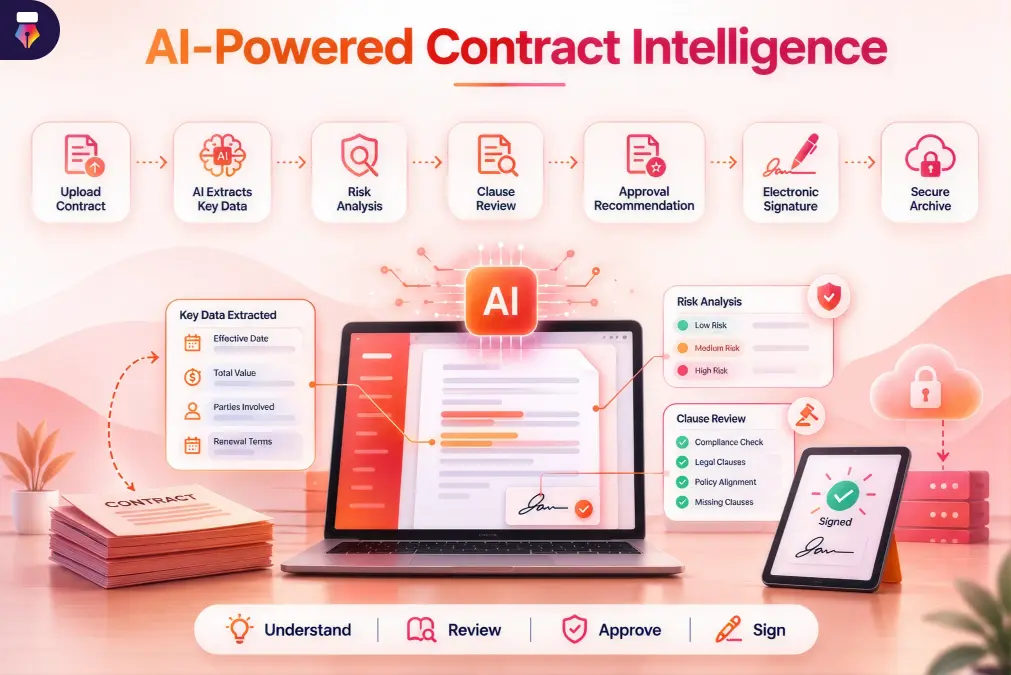
Using natural language processing, AI can identify renewal dates, payment terms, confidentiality clauses, termination conditions, and compliance requirements. It can also compare contracts against approved templates, flag unusual language, and highlight potential legal risks before anything is signed. Inkfree users can review contract terms with the AI assistant directly inside the document.
This frees legal teams, procurement, and finance to focus on strategic decisions instead of repetitive document reviews.
What AI Can Analyze
- Contract terms
- Renewal dates
- Payment obligations
- Compliance clauses
- Confidentiality agreements
- Legal risks
- Missing information
What Faster Contract Review Unlocks
- Faster contract reviews
- Better compliance management
- Reduced legal risks
- Improved document accuracy
- Greater operational efficiency
Matching AI Capabilities to Business Needs
| Business Need | Traditional Electronic Signatures | AI-Powered Electronic Signatures |
|---|---|---|
| Document review | Manual | Automated AI analysis |
| Identity verification | Basic authentication | AI, biometrics, and risk analysis |
| Workflow routing | Manual | Intelligent automation |
| Fraud detection | Limited | Real-time AI monitoring |
| Contract analysis | Manual review | AI-powered insights |
| Processing speed | Fast | Faster with automation |
| Compliance | Standard audit trail | AI compliance monitoring |
The Future of AI in Electronic Signatures
Artificial intelligence is redefining electronic signatures, turning simple digital signing tools into intelligent document management platforms. Future capabilities are expected to include predictive contract analytics, conversational assistants like the Inkfree AI assistant, autonomous workflow optimization, multilingual document understanding, and deeper integration with enterprise systems.
As the technology matures, businesses will increasingly expect platforms that do more than collect signatures. They will want systems that analyze documents, surface risks, automate approvals, and provide actionable insight across the entire document life cycle.
Organizations that adopt AI-powered electronic signatures now will be better positioned to improve operational efficiency, strengthen security, sharpen compliance, and deliver a better digital experience for employees and customers alike.
Ready to transform your document workflows with AI?
Simplify document signing with AI-powered electronic signatures. Inkfree helps you automate approvals, strengthen security, and improve business efficiency. Get started with Inkfree today.
Questions, answered.Everything you need to know about How AI Is Changing Electronic Signatures
Artificial intelligence is enhancing electronic signatures by streamlining document processing, validating signer identities, identifying fraudulent activity, improving approval workflows, and extracting insights from contracts. These capabilities help businesses improve efficiency, strengthen security, and accelerate digital document management.
AI-powered electronic signatures combine digital signing technology with artificial intelligence to automate document workflows, verify identities, detect fraud, and improve contract management. They make electronic signing faster, smarter, and more secure.
Yes. AI-powered electronic signatures improve security through biometric authentication, identity verification, behavioral analysis, fraud detection, risk scoring, and continuous monitoring. These technologies help protect sensitive documents and reduce unauthorized access.
AI detects fraud by identifying suspicious login attempts, unusual signing behavior, document tampering, identity mismatches, and other anomalies in real time. This enables organizations to respond quickly to potential security threats.
Intelligent Document Processing combines artificial intelligence, optical character recognition (OCR), and natural language processing (NLP) to automatically read, classify, extract, validate, and process information from business documents.
AI streamlines document approvals by automatically routing documents to the right stakeholders, recommending approvers, sending reminders, prioritizing urgent requests, and tracking workflow progress. This reduces delays and increases operational efficiency.
Yes. AI verifies signer identities using technologies such as biometric authentication, facial recognition, identity document verification, and behavioral analysis. This helps ensure that only authorized users can sign important documents.
Yes. AI can review contracts by identifying key clauses, extracting important information, highlighting risks, detecting missing terms, and comparing document versions. This helps businesses improve contract accuracy and reduce manual review time.
AI-powered electronic signatures help businesses automate workflows, speed up approvals, reduce manual errors, strengthen security, improve compliance, detect fraud, lower operational costs, and enhance document management.
Industries including healthcare, banking, financial services, legal, human resources, real estate, insurance, manufacturing, education, and government benefit from AI-powered electronic signatures through faster workflows, stronger security, and improved compliance.
AI improves compliance by verifying identities, maintaining detailed audit trails, monitoring document activity, detecting policy violations, and supporting regulatory requirements. These capabilities help organizations meet legal and industry compliance standards.
No. AI does not replace electronic signatures. It enhances electronic signature platforms by adding intelligent automation, advanced security, identity verification, contract analysis, and workflow optimization, while electronic signatures remain the legally recognized method for signing documents.
AI and electronic signatures work together by combining secure digital signing with intelligent automation. AI manages document classification, approval routing, identity verification, fraud detection, and contract analysis, while electronic signatures provide legally binding digital approvals.
Businesses may face challenges such as system integration, data privacy requirements, regulatory compliance, user adoption, implementation costs, and AI model accuracy. Choosing a secure and scalable solution helps address these challenges effectively.
The future of AI in electronic signatures includes predictive analytics, autonomous workflow automation, intelligent contract management, conversational AI assistants, advanced fraud prevention, and deeper integration with enterprise applications. These innovations will make digital document workflows faster, smarter, and more secure.
More on Artificial Intelligence
More articles are on the way, check back soon.