Which Industries Use E-Signatures the Most in 2026?
 Vatsal GotiLast Updated: Sep 22, 2026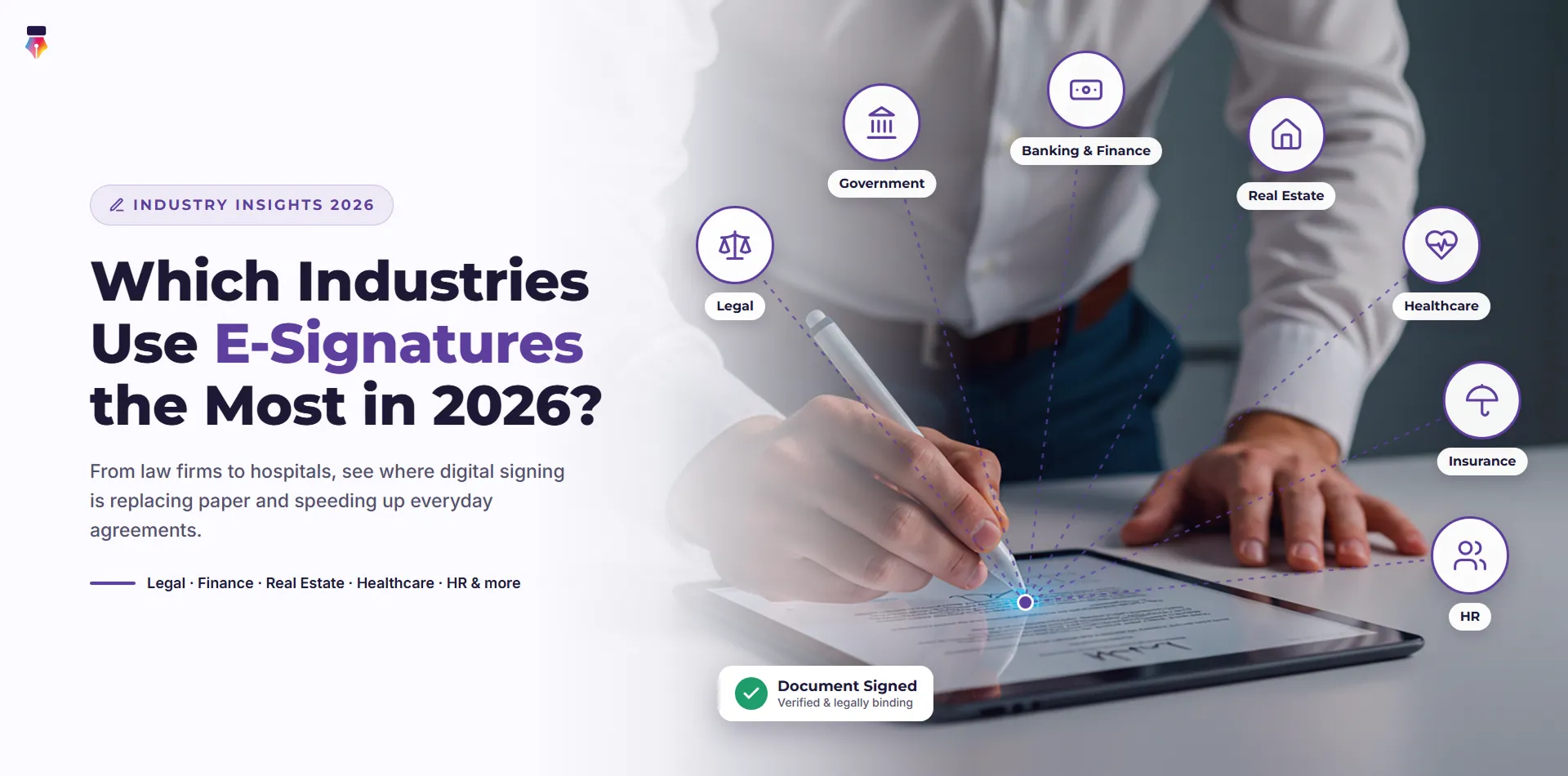
Legal services, banking and finance, and real estate use e-signatures more than any other sector, with healthcare, insurance, HR, and government close behind. The pattern is consistent: the industries that sign the most documents electronically are the ones where every transaction ends in a signature, several parties have to sign in a set order, and somebody has to be able to prove later exactly what happened.
This article walks through the industries that use electronic signatures the most, the specific documents each one signs, and the legal frameworks that make those signatures binding. If you are evaluating where digital signing would pay off first in your own organization, the sector breakdowns below are a practical place to start.
Key Takeaways: Which Industries Lead on E-Signatures
- Legal, financial services, and real estate lead adoption because their core work product is a signed, multi-party agreement.
- Healthcare, insurance, HR, and government follow, driven by document volume and record-keeping obligations rather than deal speed alone.
- Every one of these sectors relies on the same legal foundation: the ESIGN Act and UETA in the United States, and eIDAS in the European Union.
- The differentiator between platforms in regulated work is not the signature itself, it is the audit trail, the identity verification, and the access controls around it.
- A small set of documents, including wills and certain family law filings, still needs wet ink or notarization depending on local law.
Which Industries Use E-Signatures the Most?
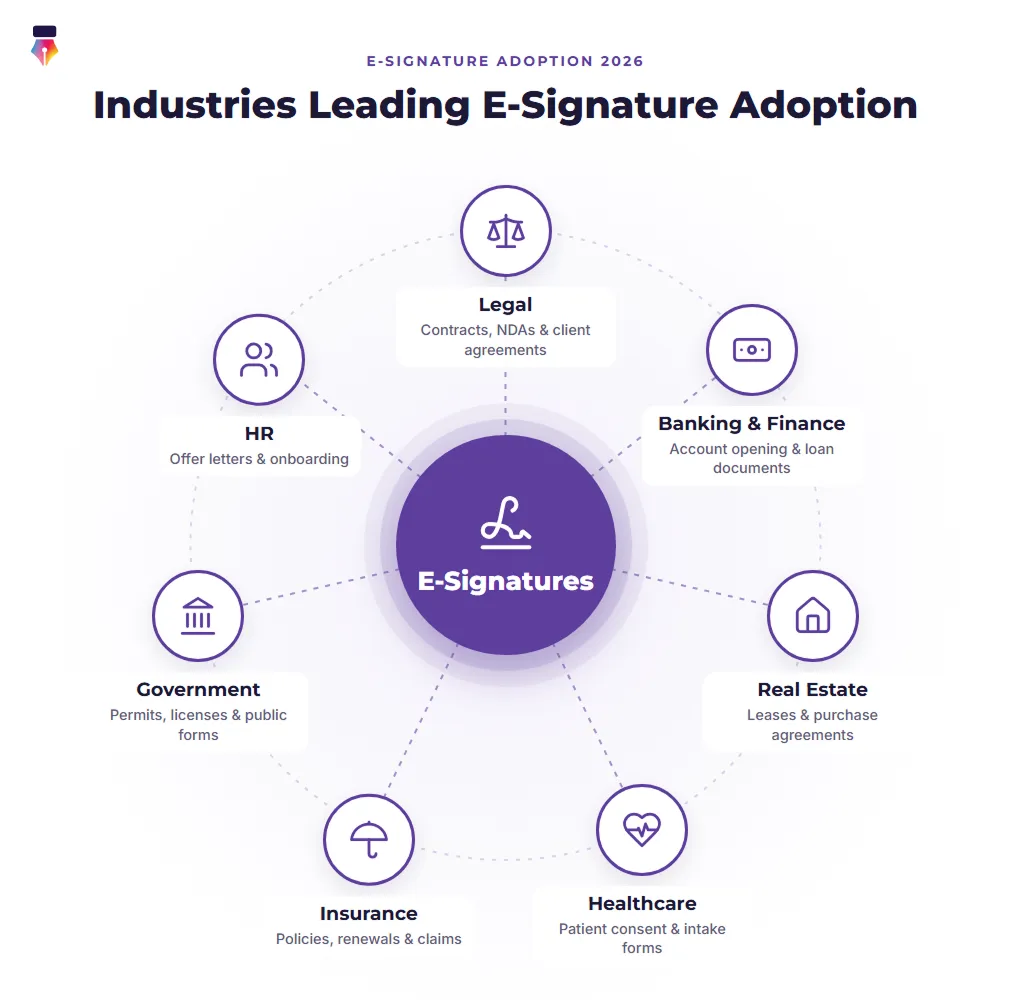
The heaviest users of electronic signatures are the industries where a document is the deliverable. Ranked by how central signing is to the daily workflow, the leaders are:
- Legal services
- Banking and financial services
- Real estate
- Healthcare
- Insurance
- HR and staffing
- Government and the public sector
What follows is what each of those sectors actually signs, and what they need from a signing platform beyond the signature itself.
Legal Services: Engagement Letters, NDAs, and Settlement Agreements
Law firms use e-signatures on almost everything that is not filed with a court. The work product of a legal practice is a signed document, so removing the print, scan, and courier steps directly shortens the time between agreement and execution.
Documents legal teams sign most often:
- Engagement letters and retainer agreements
- Non-disclosure agreements, often between several parties
- Settlement agreements and releases
- Client authorizations and consent forms
- Vendor and co-counsel agreements
What legal practices need beyond the signature is evidence. A tamper-proof audit trail that records every view, verification, and signature, plus a certificate of completion attached to the executed agreement, is what turns a digital signature into something defensible if the execution is ever questioned. Multi-party matters also depend on signing order, so each party signs in the sequence the agreement requires. See how firms set this up on the legal services page.
Banking and Financial Services: Onboarding, Lending, and Disclosures
Financial institutions use e-signatures to compress client onboarding, which is where most of the paperwork sits. Account opening alone can involve agreements, KYC authorizations, and several disclosure acknowledgments that traditionally arrived as one thick packet.
Documents financial teams sign most often:
- Account opening agreements and KYC authorizations
- Loan agreements and credit documents, routed between borrowers, guarantors, and lenders
- Investment and advisory agreements with fee schedules
- Disclosure and consent acknowledgments
- Vendor and service agreements with internal approval before signature
Financial services is also where signer verification earns its place. On higher-value agreements, firms commonly require a one-time passcode sent to the signer, or an access code shared through a separate channel such as a phone call, before the document will open. Both events are written to the audit trail. More detail on the financial services page.
Real Estate: Purchase Agreements, Leases, and Disclosures
Real estate generates more signature-bearing paperwork per transaction than almost any other industry, and the parties are rarely in the same place. A single residential transaction can involve a buyer, a seller, two agents, a lender, and a title company, each signing different documents at different stages.
Documents real estate teams sign most often:
- Purchase agreements and offer letters
- Listing agreements and buyer representation agreements
- Lease and rental agreements
- Disclosure forms and addenda
- Commission agreements and referral forms
Property managers with large portfolios lean on bulk send for lease renewals, where the same document goes to hundreds of tenants and each one gets a personalized copy tracked individually. Note that deeds and certain recorded instruments may still require notarization depending on the jurisdiction. The real estate page covers the transaction workflow end to end.
Healthcare: Patient Consent, Intake, and Credentialing
Healthcare organizations use e-signatures to move patient paperwork out of the waiting room and to keep staff documentation current. The volume is enormous and it repeats: every new patient, every procedure, every annual policy acknowledgment.
Documents healthcare teams sign most often:
- Informed consent and surgical authorization forms
- Patient intake and health history forms
- HIPAA notices of privacy practices and authorizations
- Staff credentialing and employment paperwork
- Vendor and supplier agreements
The requirement here is control rather than speed. Patient documents need encryption in transit and at rest, verified signer identity, role-based access so only the right staff can open a record, and a timestamped audit trail documenting exactly who signed and when. See the healthcare page for the intake and consent workflows.
Insurance: Applications, Enrollment, and Claims
Insurance runs on seasonal surges, and that shapes how the industry signs. Open enrollment concentrates thousands of forms into a few weeks, which makes distribution and completion tracking more important than the individual signature.
Documents insurance teams sign most often:
- Policy applications and declarations
- Group benefits enrollment forms
- Beneficiary designations and policy changes
- Claims forms and supporting authorizations
- Renewal paperwork
This is the clearest use case for high-volume distribution with individual tracking, where one form reaches an entire workforce and the broker can see, per person, who has completed it and who needs a reminder. Automatic reminders do the chasing that would otherwise consume the enrollment window. More on the insurance page.
HR and Staffing: Offers, Onboarding, and Policy Acknowledgments
HR teams use e-signatures at both ends of the employment lifecycle, and staffing agencies use them continuously because every placement restarts the paperwork.
Documents HR and staffing teams sign most often:
- Offer letters and employment agreements
- Onboarding packets, including tax forms and handbook acknowledgments
- Contractor and freelancer agreements
- Policy updates and annual compliance acknowledgments
- Separation and exit documentation
Speed matters most on the offer letter, where a candidate weighing two offers may sign whichever arrives first. Onboarding is a different problem: it is a stack of documents that should feel like one task, which is why HR teams build reusable templates for the whole packet rather than assembling it per hire. See the HR and staffing page.
Government and the Public Sector: Procurement, MOUs, and Citizen Forms
Public sector agencies adopt e-signatures to remove physical routing between offices, which is often the slowest part of a public process. Accountability requirements make the audit trail as valuable as the time saved.
Documents public sector teams sign most often:
- Procurement contracts and vendor agreements
- Inter-agency memoranda of understanding
- Grant agreements and funding documents
- Permits, licenses, and citizen-facing forms
- Internal authorizations requiring several levels of approval
Agencies typically need internal sign-off before a document ever reaches an external party, which is what approval workflows handle: the contract passes through each required reviewer, in order, with every step documented. The government page has the procurement and MOU workflows.
Which Industries Are Adopting E-Signatures Fastest Right Now?
Beyond the leaders, adoption is accelerating in sectors that were slower to move because their paperwork happens away from a desk or across many small transactions.
- Construction, where change orders, subcontractor agreements, and lien waivers are signed on site from a phone or tablet.
- Education, where enrollment packets, parent consent forms, and faculty contracts arrive in seasonal waves.
- Technology, where MSAs, NDAs, and data processing agreements route through legal and security before anyone signs.
- Life sciences, where clinical trial and CRO agreements carry strict documentation requirements.
- Manufacturing, retail, professional services, and non-profit organizations, where supplier contracts, franchise agreements, statements of work, and grant paperwork are all moving off paper.
What Do the Heaviest E-Signature Users Have in Common?
Four traits show up in every industry near the top of the list, and they are a better predictor of fit than sector alone.
- The transaction ends in a signature. When the signed document is the deliverable, every day of signing delay is a day of revenue or service delay.
- More than one party signs. Multi-party documents need a defined order, automatic routing, and visibility into who is holding things up.
- Someone has to prove it later. Regulated work needs the record, not just the signature: who signed, when, from where, and how their identity was verified.
- The same documents repeat. High-volume, repeatable paperwork is where templates and bulk distribution turn a staffing problem into a settings problem.
If three or four of those describe your organization, the question is not whether to adopt electronic signatures but which workflow to move first.
Are E-Signatures Legally Binding in Every Industry?
Yes, in the overwhelming majority of business and consumer transactions, and the legal basis does not change from one industry to the next.
In the United States, the federal ESIGN Act and UETA, adopted in 49 states, give electronic signatures the same legal standing as handwritten ones where the parties intend to sign and consent to do business electronically. In the European Union, eIDAS recognizes electronic signatures across all member states. Comparable legislation exists in the United Kingdom, Canada, Australia, India, and many more, which the eSignature legality hub covers country by country.
Documents That Still Need Wet Ink or Notarization
A narrow set of documents sits outside these frameworks or carries extra formalities, typically:
- Wills, codicils, and testamentary trusts
- Certain family law filings, such as divorce and adoption papers
- Some court orders and official notices
- Documents that require notarization under local law
The specifics vary by country and, in the United States, by state. Confirm with a qualified legal professional before moving any of those documents off paper. For everything else, the legality of an electronic signature rests on intent, consent, attribution, and retention, all of which a well-documented signing process supports.
How to Choose an E-Signature Platform for Your Industry
Industry needs differ in emphasis, not in kind. Use this as a checklist when you compare options:
- Evidence quality. A tamper-proof audit trail and a certificate of completion on every document, not a status label.
- Identity verification you can dial up. Per-signer options so an internal reviewer and an external counterparty can be held to different standards on the same document.
- Routing that matches your process. Sequential, parallel, and mixed signing order, plus internal approvals before a document leaves the building.
- Security controls your reviewer will ask about. AES-256 encryption at rest, TLS 1.2 or higher in transit, role-based permissions, and enforced two-factor authentication.
- Volume economics. Per-envelope fees punish exactly the industries that sign the most. Flat-rate pricing keeps a heavy month from becoming a budget conversation.
- A signing experience that works on a phone. Signers in construction, real estate, and healthcare are rarely at a desk.
Getting Started in Your Industry
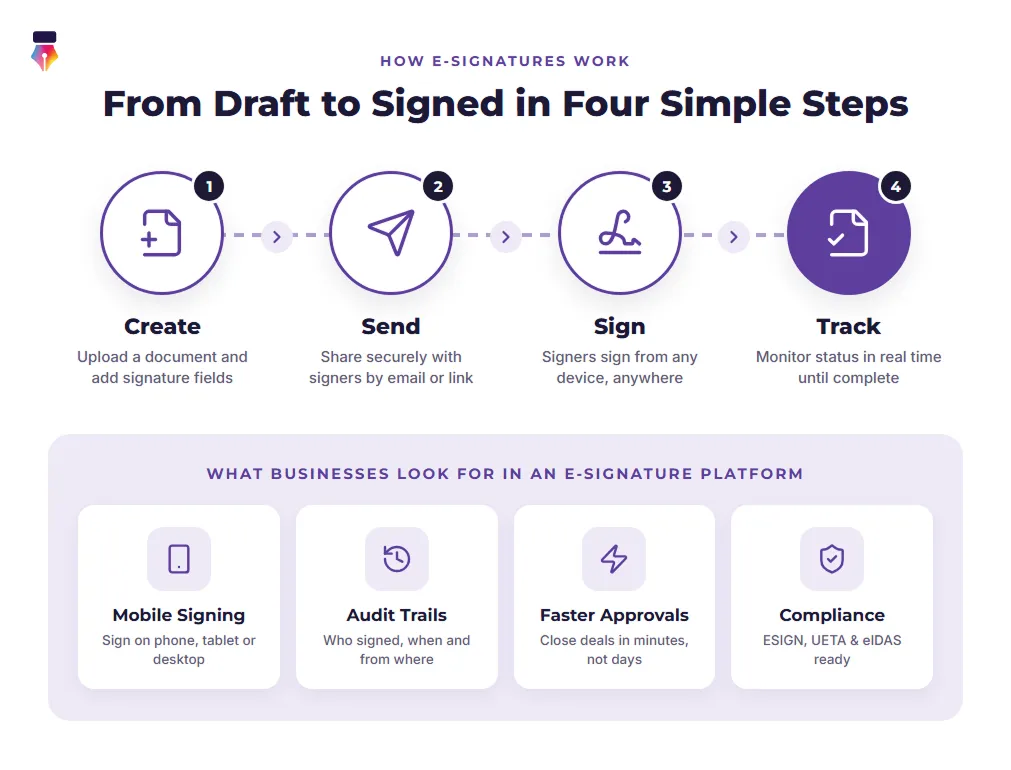
Pick the workflow with the highest volume and the most predictable paperwork, usually onboarding, enrollment, or a standard agreement your team sends weekly. Build it once as a template, set your default reminder cadence and expiration window, and send. Everything else can follow after the first workflow proves itself.
Inkfree supports every industry described above with legally binding signatures under ESIGN, UETA, and eIDAS, a tamper-proof audit trail on every document, and flat-rate pricing with no per-envelope fees. You can start for free, or see how it works first.
Questions, answered.Everything you need to know about Which Industries Use E-Signatures the Most in 2026?
Legal services, banking and financial services, and real estate are the heaviest users of electronic signatures, because every transaction in those sectors ends in a signed document and most involve several parties signing in a set order. Healthcare, insurance, HR, and government follow closely, driven by high document volume and strict record-keeping requirements.
Yes. In the United States, electronic signatures are legally binding under the federal ESIGN Act and UETA, and in the European Union they are recognized under eIDAS. Regulated industries rely on the same frameworks as everyone else, with the audit trail and signer verification providing the evidence a regulator or a court asks for.
Yes. Purchase agreements, listing agreements, buyer representation agreements, leases, and disclosure forms are routinely signed electronically. Some jurisdictions still require notarization on deeds and specific recorded instruments, so check the rules that apply to your state or country before replacing wet ink on those documents.
Yes. Account opening paperwork, loan agreements, advisory agreements, and disclosure acknowledgments are commonly executed electronically. Financial firms usually add signer verification such as a one-time passcode or an access code on higher-value agreements, and keep the audit trail as evidence of who signed and when.
Yes, for documents such as patient consent forms, intake and health history forms, HIPAA notices of privacy practices, and staff credentialing paperwork. What matters is the controls around the signature: encryption in transit and at rest, verified signer identity, role-based access, and a timestamped audit trail that documents exactly who signed and when.
A small set of documents is excluded or restricted by law, typically wills, codicils and testamentary trusts, certain family law filings such as divorce and adoption papers, some court orders and official notices, and documents that require notarization in your jurisdiction. Rules vary by country and by state, so confirm with a qualified legal professional before moving those specific documents off paper.
Look for a tamper-proof audit trail and a certificate of completion on every document, AES-256 encryption at rest with TLS 1.2 or higher in transit, per-signer identity verification, role-based permissions, signing order and internal approval routing, and pricing that does not charge per envelope so that high-volume use stays predictable.
Most teams start the same day. Upload a document, place the fields, add signers, and send. The work that pays off over the following weeks is turning your recurring documents into templates and setting your default reminder and expiration rules, which is what makes the volume manageable.